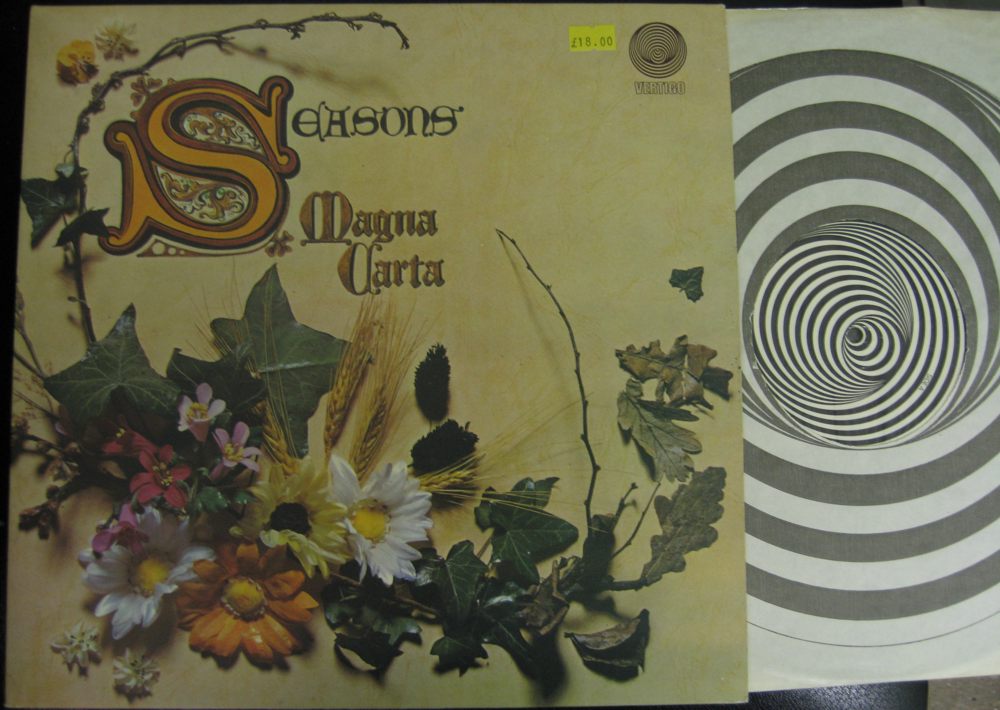
Have I ever mentioned the time our next door neighbour dropped around with some records she'd found in a dustbin? It was in 1990. Our next door neighbour in Balbriggan, Mary, was working in the Grand Hotel (which had fallen out of use for some years and which is now called The Bracken Court Hotel) when it was undergoing renovations. Parts of the grounds of the hotel had been untouched for years, and I like to think that it was in that part of the hotel that she made her find. She'd discovered about seven or eight vinyl LPs in a forgotten dustbin. She had no use for them herself but knew that my brother had a big record collection so she thought he'd like them. The records were (if I remember correctly):
Black Sabbath "Black Sabbath" (Vertigo, 1970) Magna Carta "Seasons" (Vertigo, 1970) Free "Tons Of Sobs" (Island, 1969) Blood Sweat and Tears "Blood Sweat and Tears" (Columbia, 1969) Rock Workshop "Rock Workshop" (Columbia, 1970) Jimi Hendrix (I'm not sure which but I know it was a cheapo live album, possibly "Isle Of Wight Live" from 1971) The Edgar Broughton Band "Wasa Wasa" (Harvest, 1970) Pete Brown and Piblokto! "Thousands On A Raft" (Harvest, 1970)
They were all original vinyl copies in various states of distress, most of them were in gatefold sleeves, some were almost unplayable. My brother and I were familiar with some of the names there; Black Sabbath, Free, Blood Sweat and Tears and Jimi Hendrix. We had no idea who the others were. In fact I seem to remember my brother writing off to Mat Snow at Q Magazine to find out more details about these artists. This was a long time before the internet of course. I have since discovered that Pete Brown was involved with Cream and co-wrote their biggest hits.
The really brilliant thing about it was it was like discovering a time-capsule from 1970. And some of the records were brilliant, particularly "Black Sabbath" which also has just the most fantastic sleeve art. Earlier this week I dug out the records from above which I still own; Sabbath, Magna Carta, Rock Workshop and the severely warped Free record (it was like that when we got it). Magna Carta's "Seasons" has really grown on me over the years. Because this childhood memory has fired my imagination ever since, I have recently bought some prog-folk-rock box sets; Island's "Stranglely Strange But Oddly Normal: The Anthology 1967-1972", Harvest's "A Breath Of Fresh Air 1969-1974" and Vertigo's "Time Machine: The Anthology". Each set has three discs and a very detailed booklet (typically running to 40 pages and featuring band biographies and release dates etc.) And the music is largely brilliant. I'm going to collect up as much of this stuff as I can get. Even if it has to be on CD.
I'm quite obssessed with the very late 60s and early 70s now. Really the years 1969, 1970 and 1971 specifically. I even love films from that period. Especially creepy old horrors from the early 70s; things like "And Soon The Darkness" - a thriller thing with Michelle Dotrice in it which I remember staying up late to watch when it was shown on ITV in 1990 (it was a bit crap but that doesn't matter, I still might buy the DVD), "The Wicker Man" and "From Beyond The Grave" (both of which are from 1973) and old Hammer Horrors. That's the sort of time period covered in the records we found that day. I wonder who owned them originally? He was obviously a bit of a rocker with "a sensitive side". How long had they been in the disused hotel?
Yesterday I discovered this great website which is devoted to the early Vertigo "swirl" releases. There's nothing like fussing over old record sleeves, and those old Vertigo releases were beautiful things. Hope you enjoy perusing that site as much as I do.
I was wondering what I would put in a 2008 time capsule that might be discovered by some kids in the year 2030? If any readers have any suggestions I'd be interested to hear them.
His catalogue extends to just three proper studio albums and a clutch of posthumous compilations, but Nick Drake’s influence has been enormous. His records didn’t sell much when he was alive, but his legend is now such that in 2007 a BBC Radio 2 documentary on Drake was narrated by Brad Pitt. More importantly, he was an extremely gifted songwriter and talented musician. Sometimes I feel that the fact that he apparently commit suicide overshadows his work, and it can be tempting to portray Nick Drake as a desperately lonely, depressed voice crying in the wilderness. Personally, I think Drake was a great artist, and as is the case with all great art, the truth is a little more complicated than that.
By all accounts Drake was a shy, withdrawn figure. Here’s a short extract from Joe Boyd’s book “White Bicycles”, where the author talks about calling Nick for the first time to express an interest in hearing some of his demos:
“Uh, hello?” The voice on the other end of the line was low and soft, almost embarrassed. In the years to come, I would get used to Nick Drake’s way of answering the telephone as if it had never rung before. When I told him why I was calling he was surprised. “Oh, ok, uh, I’ll bring it in tomorrow.” He appeared at my office the next morning in a black wool overcoat stained with cigarette ash. He was tall and handsome with an apologetic stoop: either he had no idea how good-looking he was or he was embarrassed by the fact. He handed me the tape and shuffled out the door.
Stories like the one above have contributed to the mythology surrounding Nick Drake. It helps that on record, Drake’s voice is soft and gentle. So the image of the middle class, university educated poet is hard to resist; Drake is seen by some as a depressed, isolated figure who had led a rather charmed life in some respects. Drake was born in Rangoon, the son of a doctor, and he had attended public school in Marlborough. Well-posh. In Patrick Humphries’ excellent Nick Drake biography he mentions that, at one point at Marlborough, Drake had played in a band with one Chris De Burgh, adding that De Burgh was sacked from the band for being too short! It seems that many people admire rock’s outsiders, and while Drake certainly had links to the proper establishment (not just the rock establishment), I think it is his singularity, his peculiar talent for addressing subjects like the fleeting nature of fame and human isolation which endear Nick Drake to so many people so many years after his death.
I’ll write a little here about Nick Drake’s three main albums, all of which I believe to be essential listening for fans of English folk, or rock music of the late 60s/early 70s. Starting with 1969’s Five Leaves Left which was produced by Joe Boyd. Initially it was felt that Nick should work with a professional string arranger, but after some faltering sessions with Richard Hewson (James Taylor’s arranger) it was decided that Drake’s friend from Marlborough Robert Kirby should take on that role. Kirby had worked with Drake before any recording contracts or studio time had been negotiated, and it was felt by some people at those initial Drake-Kirby sessions that this was a bit of risk; to let an ‘unknown” amateur take the reigns could be an expensive folly. As they soon discovered, and as we all know now, Kirby’s arrangements are beautiful, and it’s impossible to overstate their importance on Nick Drake’s records. When they combine, Nick’s loud, ringing, finger-picking guitar and Kirby’s strings are one of the great joys of modern English music. Five Leaves Left is the example par excellence of this sound. It is sustained over ten extraordinary songs. On “Way To Blue” we’re left with just the strings and Nick’s vocal and it is probably my favourite song on the album. “Time Has Told Me” which opens the set is a combination of chiming acoustic and electric guitar and piano. Elsewhere “Cello Song” is as hypnotic a song as you could wish to hear in Drake’s catalogue. For me, it’s a record that’s full of colour and changes of pace and mood; there’s never an overly abrupt break in this mood, but listening to the cold wintry sounding “River Man” and then thinking about the bright “Thoughts Of Mary Jane”, I can’t help but be struck by the broad palette of sounds and moods contained on this album.
On 1970’s Bryter Layter, it sounds like an effort has been made to make a glossier, more produced-sounding record; perhaps an attempt at having a proper hit album. It seems that Nick was uncomfortable with being a marginalized talent, that he yearned for recognition, and the constant waiting for success to happen bothered him immensely. “Hazy Jane II” is startlingly upbeat. If it does represent a proper attempt to make an obvious pop song, I’m not sure it’s entirely successful. It isn’t tremendously catchy, and it sort of shambles along on a wind of brass. Drake is further back in the mix and sounds a bit lost. It is quite out of step with the rest of the album. “At The Chime Of A City Clock” is more representative of Nick Drake’s output overall – more downbeat and introspective and subtly arranged. Here we encounter a lone saxophone, which actually sounds like it has a right to be there and adds to the song where on “Hazy Jane II” the brassy bits distract the listener. The highlight of Bryter Layter for many, myself included, is “Northern Sky”. Joe Boyd, impressed by John Cale’s arrangements on Nico’s The Marble Index invited the ex-Velvet Underground member to contribute and the end result is just wonderful. “Fly”, was recorded at the same time, also with John Cale. Another personal favourite from this LP is “One Of These Things First”, again just a gorgeous mélange of piano and guitar with a drum part so subtle it’s almost subliminal. Perfect music for hangovers. “Poor Boy” is jokey and self-mocking in a way which is just great and a nice reminder that Nick Drake wasn’t necessarily this tortured artist, as he is so often portayed. It features a chorus of female backing singers bellowing “A poor boy! So sorry for himself!” It’s a solid album, but in some ways it feels like an end of the road, because from here on Nick became withdrawn to the point of losing contact with his friends and all of the people who wished to further his career and nurture his talent.
Nick had lost contact with his record company, management and friends by the time Pink Moon was recorded in 1972. An announcement/advert was issued in the music press to this effect: “PINK MOON – NICK DRAKE’S LATEEST ALBUM: THE FIRST WE HEARD OF IT WAS WHEN IT WAS FINISHED”. This is how the album was launched on the public. Nick had recorded the album without telling anyone but the engineer. By this time Nick was utterly disenchanted with the music business and seemed resigned to being a cult figure. The album itself is bleak and initially intimidating but it has gone on to be his biggest selling album. The standout tracks for me are the title track, “Road” and “Things Behind The Sun”. It’s a terrific, introspective record. Within months of its release Drake had a mental breakdown and was hospitalized. His subsequent recordings can be found on a compilation called “Time Of No Reply”. If anything, they’re even darker than the “Pink Moon” material. “Black Eyed Dog” is especially painful to listen to, Drake’s voice is shaky and distant – here he does sound like a man at the end of his tether.
The “Fruit Tree” box set has recently been reissued and features the three studio albums and a documentary DVD (parts of which are also available on YouTube). I’d recommend the box to anyone, but if you wanted to just tip your toe in the water as it were, the “Way To Blue: An Introduction To Nick Drake” CD compilation on Island is an excellent place to start. You’ll want to buy up everything else by the man anyway. I also recommend Joe Boyd’s superb autobiography “White Bicycles” and the Patrick Humphries biog “Nick Drake: The Biography”. Both books are examples of rock writing and its absolute best. Therein you can read about Nick’s formative years, in-depth analysis of his recordings and anecdotes and commentary from his family, friends and colleagues. I like the stories about Danny Thompson joking around with Nick in the studio, and Beverley Martyn plying Nick with chicken soup.
Because It's Important To Support Salvage Operation...
You'll notice that we don't upload albums in their entirety, but prefer to post three or four tracks at most from any given LP. This is because I think it's worth going out and trying to buy any albums I mention in here, it supports the artists involved and helps keep 'ver industry ticking over, keeps record shops open and that sort of thing. It might also be because I'm hopeless at making those ".zip" file thingies. Any mp3s we do post are for sampling only, by way of introducing you to all of those lovely records out there which you ought to be buying.
Actually, there was a brilliant record shop in Bray called "Atom Records" - just outside the DART station. I was a regular in there throughout the nineties, perusing its enormous tape section and vinyl racks, or rifling through the old copies of NME and Select they had gathering dust on the floor. Last time I was in there (in January 2008) I bought a heapload of old LPs, chatted for a bit with the bloke who ran the shop (as you do), and because he was a kind-hearted and generous sort, he handed me a few copies of Smash Hits from 1978-79 free of charge. Just out of the goodness of his heart. I discovered two weeks ago that the shop has now closed. This is a travesty. These places are little Aladdin's Caves. If mp3 blogs are putting paid to places like that, then all we have fought for is a sorry lie and you can keep your "sticking it to The Man".